Wednesday, December 19, 2012

Richard III Inn Redone Using 3D Printer

This 3D printing is getting quite remarkable.

A group of archaeologists have put their 3D printer to use cranking out parts of a model of a building that they think might have been used for a night by the famous Richard III, he of the "My kingdom for a horse" fame.

Seems a 19th Century architect left a notebook with a very detailed drawing of the Blue Boar Inn, where Richard stayed the night before the Battle of Bosworth Field. Henry VII's Yorks carried the day, won the Wars of the Roses, and created the Tudor line. Richard met his end that day.

The University of Leicester archaeologists got to work and turned the 19th Century drawings, which included measurements and descriptions of the tiniest detail, into 21st Century three-dimensional walls and roof, with a bit of CAD modeling thrown in in the middle.

Now that the model is complete, the reconstructers can get on to building the real thing.

Tuesday, December 11, 2012

Carvings Show Egypt's 1st King

Recently rediscovered carvings show scenes from the reign of Egypt's first king.

The carvings, recorded in 1890s and rediscovered in 2008, show a figure wearing a white crown and traveling in a ceremonial procession and on a sickle-shaped boat, accompanied by representations of falcons and bulls. Most importantly, researchers have dated the carvings to between 3200 B.C. and 3100 B.C., which would have been during the reign of Narmer, who united Upper Egypt and Lower Egypt into one nation.

The seven carvings, made in and around the village of Nag el-Hamdulab, clearly show a pharaoh and, in one instance, illustrate a tax collection campaign. Another carving shows what looks to be the brewing and drinking of beer, which would point to a festival that could have been associated with pharaoh recognition.

Other carvings illustrate the herding of animals, including not only pedestrian cattle but also beasts that are part-lion.

The research appears in the December issue of Antiquity.

Thursday, November 1, 2012

Oldest-known Settlement Found in Bulgaria

It looks like a group of Hobbit-holes, except that it's way, way older than that.

Archaeologists working in Bulgaria have unearthed the oldest prehistoric town yet found on the European continent. The current estimate is that the structures go back as far as 4700 B.C. For those keeping score at home, that's more than a century and a half before those folks we call the Greeks got around to organizing themselves into city-states.

The settlement, named Solnitsata, is near the modern town of Provadia and has certainly proved itself to be a treasure trove, of more than one variety. About 40 years ago and not too far away, archaeologists found a huge hoard of golden objects, the oldest found anywhere, near a town called Varna.

Gold is certainly valuable today and would have been back then as well. But what the recent expedition has discovered at Provadia that would have been far more valuable back then is evidence of a large local salt supply.

Since the dawn of civilization, people have used salt as a preservative, most notably for food, and as a soothing additive to hot water for a restorative bath. Salt was for thousands of years a sought-after commodity. Roman soldiers were at one time paid in salt. (Indeed, the word salary comes from the word salt.)

Archaeologists also unearthed impressive reinforced houses and a stone wall, suggesting that the Solnitsatians went to some length to protect their salt stash.

Other expeditions have unearthed similar salt mines in nearby areas, near known copper and gold mines.

Monday, October 29, 2012

CT Scans Reveal 'Faces' of Mummies

Modern technology has revealed the faces of four people embalmed 2,000 years ago.

A group of New York scientists combined CT scans and the artwork of a crime artist to create sketches of the faces of those embalmed. Then, the scientists compared the new sketches to the portraits that were stored next to the mummies. In two of the four cases, the matches were nearly exact.

The artist, who knew only the age and gender of the deceased, took seven days to produce each sketch. The sketches of the two mummies from the British Museum matched their portraits almost exactly. The other two mummies, one from the Glyptotek Museum in Copenhagen and the other from New York's Metropolitan Museum of Art, didn't fare so well in the portrait-matching department. Still, they weren't far away.

The art historians involved will be happy to have some evidence that portrait production was more about realism in the 1st Century A.D.

The relative success of the sketching suggests more uses for modern technology.

Friday, October 26, 2012

Study: Alexandria City Design Followed the Sun

Leave it to Alexander to bring the Aten into it.

The Egyptian metropolis of Alexandria was built so that the main road aligned with the rising Sun on Alexander's birthday, according to a study out of Italy. The study, which was reported in the Oxford Journal of Archaeology, quoted computer simulation data that reinforced the idea that the Canopic Road, the city's main east-west road, was so oriented on July 20, the day of Alexander's birth.


Using sophisticated equipment and calculations, a team led by Milan archaeoastronomer Giulio Magli found that in the fourth century B.C., the Sun rose less than half a degree off the direction of the road. (Alexander was born in 356 B.C., and he founded Alexandria in 331 B.C.) The study also found that a second star, Regulus, would have risen in the same part of the sky at about the same time on that date. Incorporating Regulus, known as the "King's Star," would have been a nice touch for Alexander and his city planners.

Using the Sun as an architectural tool would have been nothing new to the Egyptians, who often cited Ra (or, in Akhenaten's terms, the Aten) as inspiration for all manner of things, including rulers and their grand buildings. That Alexander chose to do so would have been entirely in keeping with his status as the new pharaoh of Egypt.

Thursday, October 25, 2012

Cat's Grotto Hideaway an Ancient Tomb

In a story of the living and the dead, two Romans followed a cat into a grotto and discovered a 2,000-year-old tomb. This happened not many years ago but mere days ago.

Seems the men found a cat in a residential area near one of the city's main streets and then, when the cat disappeared into a grotto, followed it inside. What they found was human bones in various places on the floor and niches on the walls similar to what ancient Romans used to hold funeral urns.

Sure enough, archaeologists arriving at the scene later confirmed the discovery of a burial chamber, dating from between the 1st Century B.C. and the 2nd Century A.D. The bones, the archaeologists said, probably fell from a higher spot.

As to why the tomb hadn't been discovered before, the theory is that recent heavy rains have caused erosion that sheared away what had been rocks that, intentionally or not, had concealed the chamber.

What to call the newly found chamber? A cat - a - comb, of course.

Monday, October 1, 2012

Bonnie & Clyde Guns Bound Together at Auction


Their owners were lovers and partners, and their guns stay together as well.

They are Bonnie Parker and Clyde Barrow. Their guns survive them as a pair, thanks to an anonymous Texas collector who paid a collective $504,000 for the two pistols sold at a New Hampshire auction.

Barrow was 25 and Parker 23 when they were killed in 1934, the result of a two-year manhunt following a multi-state crime spree involving killings, kidnappings, bank robberies, auto thefts, and a prison break. A combination of Louisiana police and Texas Rangers found Bonnie and Clyde in a northern Louisiana hideout, and the following firefight left the outlaws dead.
The two were lovers, and their story captured the popular imagination for a time during the Great Depression. But it's the tangible things they left behind that were on display at auction.

Parker's gun, a .38 special that was found taped to the inside of her thigh, brought in $264,000, slightly more than the $240,000 paid for Barrow's gun, a Colt .45 that was found in his waistband.

The guns came from the collection of another memorabilia enthusiast, who bought them for about $100,000 total in 1986.

Other items sold at this most recent auction included Barrow's gold pocket watch ($36,000), a silver dollar taken from his pocket ($32,400), and one of Parker's silk stockings ($11,400).

Tuesday, September 25, 2012

Ben Gone, Ben Recovered: Stolen Franklin Bust Retrieved from Thief


The missing Benjamin has been found.
It's Benjamin Franklin, of course, but it's not missing money we're talking about here. No, we're talking about a lot of money, actually, in the form of a bust worth $3 million that was stolen from an elderly Pennsylvania man.
George D'Angelo, an 85-year-old retired lawyer living in the Philadelphia suburb of Bryn Mawr, reported the theft of the bust, one of three made in 1778 by noted artist Jean-Antoine Houdon, on August 24. The culprit is apparently a woman who goes by various names and used to clean D'Angelo's house. She was arrested as she got off a bus in Maryland. Investigators found the missing bust in a duffle bag she was carrying. (It's not a huge bust, weighting in at 25 pounds and measuring up at 28 inches tall.)
The cleaner, by whatever name she goes these days, faces charges of theft, fraud, and (since she crossed state lines with the bust) interstate transportation of stolen property. She had apparently been fired by her employer, the cleaning company responsible for cleaning D'Angelo's house, three days before the bust went missing. She was then, apparently, seen driving away from Angelo's house on the day that the bust went missing. The evidence would have been entirely circumstantial but for the fact that she had the bust on her person when she got off that interstate bus.
So Mr. D'Angelo can look forward to having his rare Benjamin Franklin bust back on his mantle stand soon, as soon as the FBI finish dusting for fingerprints.

Thursday, September 20, 2012

Great Caesar's Ghost Sandals


Like a good Shakespearean ghost, Caesar keeps on rising. Julius Caesar, that is, the subject of yet another story about ancient times, back in the news today, with the sandals giving it all away.

Archaeologists doing a dig in Germany have found evidence convincing them that they've uncovered the oldest known Roman military fortress in that country and that the fortress was probably built by none other than Caesar and his troops as they ripped through Gaul in the 1st Century B.C.

The dig is close to Hermeskeil, near the German border with France, and parts of the fort have been known for a few hundred years but have been covered up or eliminated through the normal wear-and-tear of civilization.

Now, though, the archaeologists who have been working at the site for the past couple of years have identified nails from sandals belonging to Caesar's soldiers (along with potsherds, of course) that tie the time to the place and the man to the time, as it were. 

The fort, by the way, is impressive, measuring about 45 acres, along with an 18-acre annex, which was once complete with a water spring.

So far, no Veni Vidi Vici graffiti (conjugated or not) has been found. It's only a matter of time, though. Caesar had a high opinion of himself and would have left some kind of calling card. Maybe they'll find some dice.


Tuesday, September 18, 2012

Drought Reveals Sunken Treasures

Mother Nature will always have the last laugh. Sometimes, we can share in it.

That's the situation in Poland, where a record low in the level of water in the Vistula River caused by a recent drought has unveiled a bunch of treasures stolen by Sweden invaders in the 17th Century. Seems the Swedes were eager to get away or too greedy or whatever and they loaded the barge too much and the whole thing sunk to the bottom of the river. They had planned to move the marble up the river from Warsaw to Gdansk and then out through the Baltic Sea, but it wasn't to be. And, not being skilled in dredging (or for some other mysterious reason), the Swedes decided to leave the stuff behind.

 The Vistula, the country's longest river, was a bit of a dumping ground during World War Two as well, as first Nazi Germany and then the Soviet Union occupied cities along the river. The same low water levels have revealed artifacts from the 1940s as well, and researchers have said that some recently uncovered Jewish gravestones would be turned over to Warsaw's Jewish Historical Institute.

 The heavy stuff stolen by the Swedes includes large blocks of carved marble that formed part of the foundation and interior of some splendid Polish palaces. It's not exactly lightweight, which is another reason that it has remained on the bottom of the river bed all these years. But, the drop in the water level of the river has effectively brought the marble closer to the surface and so modern technology can, without a supreme effort, get that marble out of the river and onto archaeologists' work tables where it belongs.

Paradoxically, the water level is a bit too low for the floating cranes needed to do the job. Mother Nature, always having the last laugh indeed.

Monday, July 30, 2012

Leaning Tower of Decadence: Colosseum Sinking, Engineers Report


What is it with leaning buildings? You'd think they'd get it right by now. But now comes word that the Colosseum, one of the most famous and recognizable relics of the successes and excesses of the Roman Empire, is on a slant, more than a foot lower on the south side than on the north side. I guess, though, the first serious settling in a couple of millennia is a wonder to behold.


The Romans built things to last: temples, baths, roads, aqueducts. They didn't do so well with less tangible things like the Republic or the Empire, but they sure knew how to use stone to good effect.


You could argue that not too many Roman roads are around anymore, and that is true, in large part because we've found better uses for that land, like building modern roads or settlements. Earthquakes have claimed more than a fair share of temples and aqueducts through the years. Some of the more famous temples are still standing, as are some amazing aqueducts. Other buildings are still wish us, most notably the Colosseum. But it's sinking, the result no doubt of thousands of years of erosion.


You'll remember that the Leaning Tower of Pisa was leaning a little too much in recent decades and had to be closed for a significant period of time while engineers made sure that the Leaning part of the Tower wasn't enough to make it topple on some poor tourists just in for the day. The same thing could well happen to the Colosseum, although closing it for a prolong period of time could well put a dent in Rome's tourism revenue. Still, better safe than sorry, better repairing the big ring instead of letting it topple over on some poor motorists just in for the afternoon.


Speaking of motorists, scientists are studying traffic patterns, to see how much the constant vehicular traffic affects the crack in the Colosseum base that has opened up a fraction in recent years. 


Things aren't urgent. Scientists are happy to wait for a year's worth of scientific studies before recommending any sort of strengthening or straightening. Still, if seeing the Colosseum in person is on your bucket list, then maybe book in a trip in the next year or two, just in case.

Friday, July 6, 2012

'Atlantis' Disappeared Round British Isles


Not to be outdone in the Atlantis sweepstakes, a British museum is displaying artifacts from a long-ago submerged society called Doggerland.

Among the artifacts recovered after a series of deepsea dives at the bottom of the North Sea are hunting tools such as harpoons and fish prongs, as well as fossils of mammoths.

The theory is this Doggerland was a massive bit of land connected to the Continent that stretched Denmark, Scotland, and the Channel Islands. Trade with the European mainland (as we now know it) would have been extensive in those days — those days being the end of the last Ice Age. After that time, between 10,000 and 8,000 years ago, the rising sea levels slowly put Doggerland underwater, in the process creating the English Channel (as we now know it) and making the British Isles into what they are today.

The good scientists in the U.K. have consulted geophysical surveys and used their handy computers to create three-dimensional versions of what they think Doggerland looked like. The 3D mapping includes topographical differences like peaks and valleys dotted on the landscape, near evidence of lakes and rivers.

As for Atlantis, well no one really knows still where it was, when it was, or if it was. The evidence that we have is so sketchy that many historians have concluded that it is a morality tale only. For others, though, the search goes on.

Tuesday, June 26, 2012

Greek Subway Dig Unearths Roman Road


Well, this might give the ancient home of democracy a shot in the arm: Digging deep beneath the streets of Thessaloniki, Greece's second-largest city, has revealed the remains of roads built more than 2,000 years ago. Timing is everything in the archaeology business — or is that the advertising business?
The government has made a big show it if nonetheless, with a public display of the marble-paved road that just happens to be decorated with illustrations of children's games and cart wheels. Archaeologists also found lamps and other tools, as well as bases of marble columns, lending an air of authenticity to the whole thing.
The road getting all the attention is the Roman one (naturally), which was laid down 1,800 years ago. But (typically) it is the Greek road that is even older (naturally), by about 500 years. So obviously, these civilizations knew what they were doing when they built certain things to last. They also knew what they were doing when carving out transportation routes, since modern roads more or less parallel (vertically) several ancient roads.
It's all part of a subway project that was begun in 2006, in the afterglow of the Olympics, and has yet to be completed. Part of the delay came when diggers discovered more than 1,000 graves. Some of those graves contained treasure, and that had to be sorted out.
The long-range plan is for the subway system to have 23 stations. That leaves another whole buried world to discover.

Friday, June 22, 2012

Easter Island statues 'walked': new theory


A pair of scientists have announced a new theory for how the monstrous Easter Island statues were transported: they "walked."
An archaeologist from California and an anthropologist from Hawaii have demonstrated their theory by building their own comparatively smaller moai and using really strong ropes and a large group of people. The demonstration featured ropes tied to three of the giant statue's four sides (left, right, and back), and the volunteers moved the ropes ever so slightly back and forth, approximating a "walk."
It's the latest in a series of explanations for how the island's residents were able to move around such large structures without using heavy machinery. One widely regarded theory supposes that the island's residents cut down lots of trees and fashioned sleds on which to transport the statues. That theory, so the story goes, conveniently explains the population decrease because of the antecedent deforestation.
The proponents of this latest "walking" theory propose that the real reason for the dropoff in population on Rapa Nui was a lack of immunity to diseases brought by European "visitors."
Both theories suffer a bit when tightly reviewed, actually. If the islanders "walked" the statues, then they certainly took risks all along the way that the statues would tumble over in transit. The model moai weighed 5 tons, much less than the standing statues, some of which weighed in at 90 tons. Much safer to "sled" the statues around, unless you're eventually wanting to stand them up, which is what happened, at which point the same toppling risk would ensue, just not as much as during a "walk."
Of course, a completely implausible explanation is that the ancient (or alien) civilization that supplied the Egyptians, Sumerians, and half a dozen other peoples who experienced a "sudden and great leap forward in technology" had a giant crane or two spare and that the residents of Rapa Nui borrowed the cranes for a bit. That theory doesn't stand up to even a loose review. 
As to the real story, we might never know. After all, we haven't gotten around to inventing time travel yet. 

Saturday, June 9, 2012

Annie Oakley Auction on Target for Big Payday

It's a bull's-eye to the savings account, as a collection of Annie Oakley items goes under the hammer. 


You can spend your hard-saved cash on the legendary yet all-too-real Annie's guns, her Stetson hat, and mundane items like letters and pictures. It's all part of a Heritage Auctions production featuring 100 items put forward by Oakley's descendants.

Tommye Tait and Terrye Holcomb, two of Annie's great-grandnieces, now own the items, and many more like them, having inherited them all from their mother, Billie Butler Serene, who died three years ago. In true family tree fashion, Serene was reared by her grandfather, who was the brother of Frank Butler, Annie Oakley's husband and manager. Turns out that Serene learned how to handle a gun from Annie herself.

The famous Stetson hat is expected to sell for $4,000. That's nothing compared to the even more famous 12-gauge Parker Brothers shotgun, which is expected to go to some lucky collector for $100,000. (If you're gun-inclined but don't have that much walking-around money, you can settle for a Marlin .22-caliber rifle, which could be yours for a mere $22,000.)
See, this is famous stuff, wielded (or worn) by a famous lass, who was larger than life in her day and even more larger than life in the years after her day. It's a marvel, really, that these items haven't been put on public display before. (The hat, the family says, was a treasured item at family dress-up parties.) The family took all-in-the-family to heart and kept all of Annie's stuff close to home. 
The photos should be of special interest to historians because they feature formal portrait of Annie — with her gun. 
This is not the only Oakley-related collection, of course. You can find lots of authentic Annie stuff in various locations around the country, including the Buffalo Bill Historical Center and, of course, the Annie Oakley Center. 

Sunday, June 3, 2012

Stone Age Artists Did Animation on Cave Walls, Study Asserts


We're familiar with the Stone Age, right? Fred Flintstone and all of that, not to mention the complete absence of industrial machinery.

Seriously, the Stone Age was a few generations of great progress, just not very fast on the evolutionary scale, as it were. But wait a bit, what about their art?

Not known for its art, the Stone Age is, yet a new study by an artist and an archaeologist concludes that the people who painted some of the images in France's famous Chauvet cave were, in fact, animators. 

How do you like that, Walt Disney? Mickey who?

Well, it's not that serious. Disney's hold on the popular animated imagination is probably secure. But what could be in dispute is the narrative that says that the first animations happened not all that long ago.

After careful study of the paintings on the wall of the Chauvet cave, the artist and archaeologist, Marc Azema and Florent Rivere, some of the art is meant to suggest multiple versions of the same scene — in other words, animation. 

The bison that looks like it has eight legs is merely one image of a bison superimposed on another image of the same bison, to suggest movement. View the image by the flicker of a torch's light, and you see what could very well be the simulation of that bison in motion.

Well, fancy that. Presumably, you could achieve the same effect by shaking your head vigorously from side to side. The predators in the image sure look like multiple versions of the same animal, shown at slightly different times in a slightly different space. So maybe there is something to this idea after all.

The key to remember here is that these images were painted on the wall of that cave 30,000 years ago. The other thing to note is that you can read more about it in the June issue of Antiquity.

Wednesday, May 30, 2012

Roman-era Shipwreck Find Could Sink Maritime History Theory


So the story goes that the guys (for they were all guys) who sailed to sea in ancient times in order to sell their wares in other lands were dependent on coastlines to get them from place to place. Shun the open waters did these ancient sailors, the story goes, so that the capricious winds known to plague ancient seas wouldn't destroy the poor ships, which would have no coastline to tack for in desperation.
Well, not any more, if evidence unearthed (and un-watered) is to be believed. You never can tell what to believe coming out of Greece these days, especially if it has to do with money and debt and all of that sort of thing, but the culture ministry doesn't really have that sort of agenda, so maybe we take more than a grain of salt away with this report:
Two shipwrecks found deep in the sea between Corfu and Italy are of Roman-era ships. The ships were found nearly one mile deep, which would be far deeper than ships previously found. The usual depth is between 100 and 200 feet, and the usual place is along the coastline. A massive number of shipwrecks have fit this bill, but the latest two to be discovered do not.
Crews digging to put in a gas pipeline between Greece and Italy found the wrecks. A Greek oceanography crew then scanned the area, including the use of a robot submarine, and delivered footage of amphorae, anchors, ballast stones, and even cooking utensils. Some of the amphorae was produced in north Africa.
The announcement could well be a boon for Greece's struggling archaeology industry, which no doubt needs some sort of infusion before the government gets too desperate and starts selling off the Acropolis and other antiques.

Monday, May 7, 2012

Plant-eating Dinosaurs Created Their Own Greenhouse Effect, Scientists Say


Somewhere in this story is a lesson about eating too many vegetables, but we won't go there at the moment. 

No, the more exciting news is that scientists have come up with yet another reason for the massive dying out of everybody's favorite giant creatures, the dinosaurs. Seems the theory now is that the poor beasts emitted so much methane from eating plants that they created their own runaway greenhouse effect and killed themselves off in the process.

We're not really talking about T-rexes or velociraptors or any of those other raging carnivores made realistically alive and frightening by Steven Spielberg. No, the culprits here are the big beefy plant-munching targets of those carnivores, the sauropods. 

Remember that back in those days, the planet was full of tall, tall trees containing green, green leaves and that these giant skyscraping beasts would lumber along and munch on some leaves every now and then. You have to admire these big giant guys and girls for eating their greens. Doing that sort of thing certainly kept them regular, as it were, but this team of scientists led by a guy called Graeme Ruxton out of Scotland is now asserting that even regularity can be too much of a good thing and that the result of all that leaf-munching was leaf digestion that led to leaf expulsion that created big white puffy clouds full of carbon dioxide-trapping fluffiness, giving all that dino-veggie-methane nowhere to go. The result, of course, must have been chaos, as the poor beasties would have found it getting hotter and hotter, ever so slightly, and then they would have sweated and sweated and eventually overheated and fallen over (provided that they didn't get eaten by a carnivore first).

The scientists' estimate is that a 90-ton sauropod measuring 140 feet in length would have eaten half of a ton of food every day and, once that food had been digested, would have produced a few thousand liters of methane in a day. Compare that to a cow's daily output of 200 liters, and you have some idea of the runaway problem that such "additions" to the atmosphere could cause. 

Have a thought for the T-rexes of the world, too, because they wouldn't have caused this greenhouse effect but would have certainly suffered from it. Maybe they didn't eat the sauropods fast enough? It's a tricky thing, being a carnivore. You have to have that balance between gorging yourself until sated, day after day, and allowing the population to repopulate itself enough so that you can keep feeding on it and live a good long life.

Speaking of a good long life, we have to remember as well that even if this greenhouse gas theory is correct, the extinction of dinosaurs didn't happen overnight. As dramatic as the asteroid theory is, it doesn't suggest that, either. It took a good long time for dinosaurs to disappear from the planet. They had a good long time to leave lots of fossils behind — which is all we have at the moment because none of those "terrible lizards" is around anymore to tell us their rather sad little story.

Moral of the story: It's not easy eating green.

Wednesday, April 4, 2012

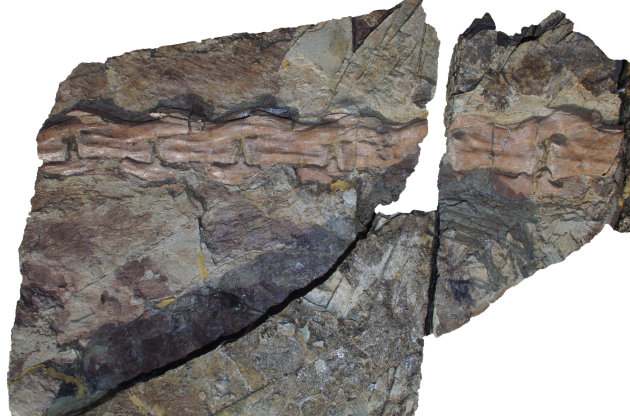
Furry T-Rex Ancestor Discovered in China


T-rex with a conscience? Could be.
A team of Canadian and Chinese scientists have discovered a new species of tyrannosaur, Yutyrannus huali, which was a bit smaller than the feared beasts of Steven Spielberg fame and had feathers. It was also a bit smaller and, apparently, a bit better-looking, judging by the translation: "beautiful feathered tyrant." (Apparently, as well, it was still deadly.)
The excavations, from a dig in northeastern China, revealed evidence of remains of down-like feathers on the dinosaur's neck and arm. It wasn't enough to convince that the "feathered" referred to a full coat or giant bird-like wingfeathers or anything like that, but the discovery did give the excavation crew pause, enough to suggest that this species, at least, might have been a bit less like the movie-version giant tyrants that we've come to see in our imaginations.
This discovery will no doubt be more grist for the mill of debate surrounding how, when, and how fast certain species of dinosaurs lost their feathers — if they had any to begin with. The patchiness of fur found in the latest remains could suggest an overall patchy covering or, perhaps, an aging dinosaur who was losing its hair, or even a young dinosaur still growing into the coat. (One suggestion was even that the beast could ruffle its feathers and show off, like today's peacock species.) Like so many things with these ancient beasts, we just don't know and we won't ever find out firsthand (despite what Michael Crichton would have you believe).
This species lived 60 millions years before Tyrannosaurus rex, so there's little chance that they were directly related. However, that's not enough time to discount a connection altogether, either, so scientists in this field will take a good long look at these data when they are writing their next journal papers.
You can find the journal paper covering this latest discovery in Nature.

Tuesday, March 20, 2012

Ghost of Genghis? Ancient Mongolian Wall 'Rediscovered'


When is the Great Wall of China not in China?

That's a question that can now be answered yet again, as a recent team of researchers has uncovered a 62-mile-long stretch of the vaunted Wall in the Gobi Desert, inside southern Mongolia. Further, this is thought to be part of the Wall of Genghis Khan, which is even more shrouded in mystery.

This section of wall is 9 feet tall in places, which fits the larger-than-life personality of the "Great Khan." (Ironically, the Great Wall was originally built in large part to repeal invaders such as Genghis Khan.)

Because the "discovered" part of the wall is in such a remote location, the exploration team think that they are the first to investigate in a very long time, perhaps since the wall section was lost to the sands of time. The team used online tools including Google Earth to put more detail to what appeared to trace elements of a structure barely seen on satellite maps. Once convinced that they were on to something, they started digging. And then, voila!

The wall sections are made of different materials, including, in one case, wet mud and shrubs. The most dominant feature, though, is dark basaltic rock, discovered in straight edges that suggest nothing so much as quarrying with intent.

The hard scientists have gotten into the act with their radiocarbon dating machines and determined that the wall section was built after A.D. 1000, which would mean at the very least that the walls were updated at that time. Initial estimates put construction during the Western Xia dynasty, which reigned from 1038 to 1227 and struggled mightily against encroaching Mongol tribes. (Genghis Khan himself was born in 1162, so the timing fits in nicely.)

The one bit of mystery that still has archaeologists a bit puzzled is the near complete lack of detritus around the walls, which is a bit of a worry if you're looking for evidence of human activity. We humans, after all, are a notoriously messy bunch of folks who by our very nature leave behind all manner of clues as to our existence: our preference for entertainment, our favorite foods, etc. But there, deep in Mongolia, at the Is-it-really-the-Wall-of-Genghis-Khan, can be found no broken pottery, no discarded weapons, no coins with strange-bearded kings on them, nothing that would point the finger at any one people as being the ones who lived near and defended the wall — which lends a bit of credence to the competing theory that the walls were built merely to herd animals (although why they would need walls 9 feet tall do that is a bit puzzling, unless they were herding giraffes). 

Scholars who have studied the ancient Mongolian scrolls theorize that Genghis Khan's son Ogedei, who was the 2nd Great Khan, wanted the walls to rein in the wandering gazelles that he liked to look after so much. But remember, as modern historians who study Mongolian times would, that the Gobi was a desert, then as now, and that not too many animals would have survived in the arid conditions without a whole lot of water — and if Ogedei had a network of irrigation canals built just to keep his pet gazelles among the living, it might explain why his own life and reign came to a sudden end.

What we are left with, then, are some facts and some questions, not necessarily related but all stimulating in an inquisitive sense. As is often the case with history, more information is needed.